

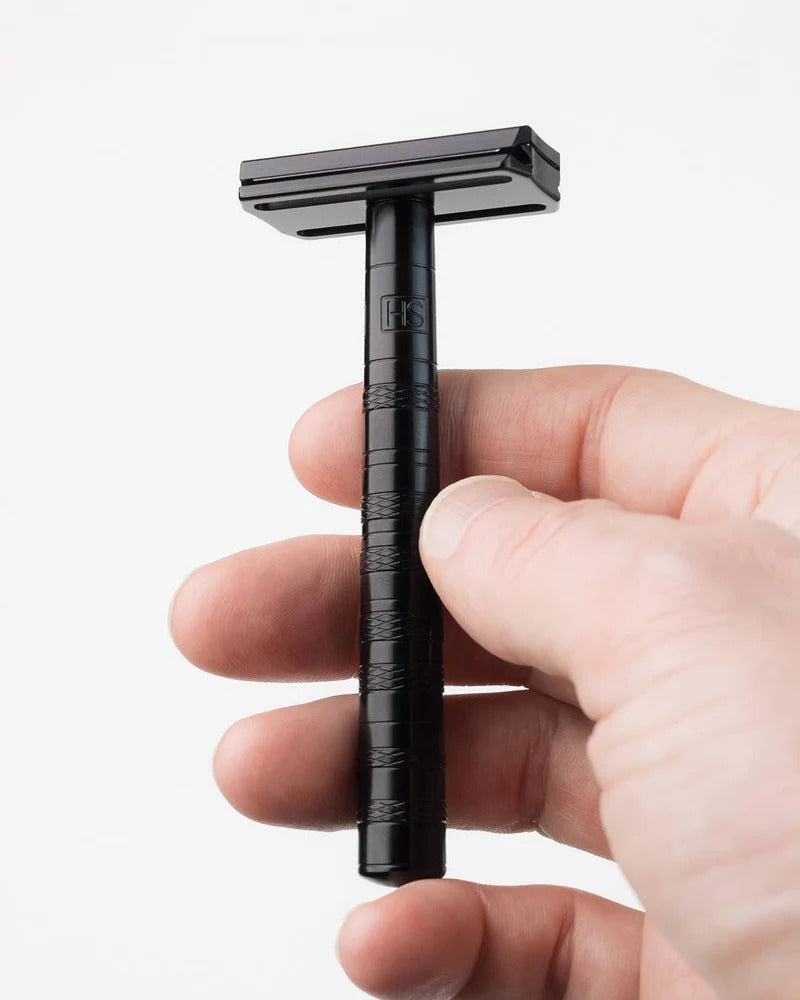
Safety Razor vs Cartridge Razor
A safety razor is worth considering if you want inexpensive replacement blades and are happy to learn a fixed-head shaving technique. A cartridge razor is a practical choice if you value a familiar pivoting head and quick, contained cartridge changes.
Both can give a comfortable shave. The choice comes down to how each fits your skin, budget, and daily routine. Here is what changes when you switch.
How the two razors work

A double-edge safety razor holds one replaceable blade with a cutting edge on either side. Its head generally stays fixed, so you guide the angle as you move around your face. You keep the handle and head and replace the individual blade.
A cartridge razor uses a replacement head made for its handle. Most familiar designs combine several blades with a pivot and a lubricating strip. You replace that assembled cartridge when it is time for a fresh cutting surface.
| Feature | Double edge safety razor | Typical cartridge razor |
|---|---|---|
| Head | Fixed; your hand guides the angle | Usually pivots to follow contours |
| Replacements | Individual double-edge blades | Compatible cartridge heads |
| Getting started | Learn the working angle and use light pressure | Often familiar if you already use cartridges |
| Changing blades | Requires handling an exposed blade carefully | Usually a contained head change |
| Running costs | Low-cost blades can reduce ongoing spending | Refills often cost more per head |
| Good fit | Someone who wants a reusable system and lower refill costs | Someone happy with the convenience of an existing routine |
Which is more comfortable

Technique matters with either razor. Wet the beard, use suitable shaving lubrication, and limit repeated passes over the same area.
If you often get razor bumps, the AAD suggests considering a single- or double-blade razor and shaving with the direction of growth. A double-edge safety razor is one way to try a single blade. It still needs a light touch and an appropriate working angle. [1]
The Henson AL13 is a great option if you want to explore that format. Its aluminum construction keeps it light, and the head has a defined shaving plane to help guide contact with the skin. Keep that plane against your face and follow Henson's instructions for pressure and handling. [2]
For a fair comparison, use a shaving product and aftercare you already tolerate while learning the new tool. That makes it easier to tell whether the razor or technique is changing how your skin feels.
What the cost difference can look like

Here is an illustrative example using an $80 safety razor, double-edge blades, like the RK Shaving Stainless Double-Edged Blades costing $15 per 100, versus a $10 cartridge handle and $4 replacement cartridges. These are calculation assumptions, rather than a live price comparison between specific competing products.
Assume 260 shaves in a year and five shaves per blade or cartridge. That gives 52 replacements in either system.
| Example cost | Safety razor | Cartridge razor |
|---|---|---|
| Handle | $80.00 | $10.00 |
| Each replacement | $0.15 | $4.00 |
| 52 replacements used | $7.80 | $208.00 |
| Handle plus replacements used in year one | $87.80 | $218.00 |
Under those assumptions, the first-year difference is $130.20. Buying the full 100-blade pack would mean paying $95 for the safety razor and blades upfront, with 48 blades left after the modeled year's use.
Your result will change with refill prices, shaving frequency, and blade life. The example excludes tax, shipping, accessories, and any blades included with a handle. Five shaves is an arithmetic assumption; replace a cutting surface sooner whenever it becomes uncomfortable or damaged.
How much changes in the morning

With a safety razor, start with short strokes and very little pressure. Give yourself time to learn the neck and jaw before trying to shave quickly. Our beginner wet shaving guide walks through preparation and the first pass.
You can usually keep a familiar cream or gel if it is intended for shaving. A brush becomes useful when you choose a shaving soap or lathering method that needs one. The change of razor alone does not require a bowl, stand, and brush.
If your cartridge already gives you a comfortable shave and easy upkeep, staying with it is reasonable. Switching makes the most sense when you have a specific reason, such as refill cost, a preference for a metal razor, or interest in trying a different blade.
Cleaning and disposal

Rinse either head thoroughly and let it dry according to its maker's directions. A safety razor creates a different waste stream because you replace a small metal blade rather than an assembled cartridge.
Collect used double-edge blades in a suitable puncture-resistant container and check local disposal or collection rules. Keep the container out of reach of children and pets. That handling step is part of owning the system.
Common questions
Will a safety razor shave closer than a cartridge razor?
Either format can produce a close shave. Your beard, the razor's design, and your technique affect the result. When comparing them, pay attention to comfort later in the day as well as smoothness immediately afterward.
Can I keep using my current shaving cream?
Yes, if it is a shaving product that provides suitable lubrication and you use it as directed. Keeping it familiar can make the switch easier. Refresh any area that dries before shaving it.
Can I use both kinds of razor?
Yes. You might keep a familiar cartridge for rushed mornings while practicing with a safety razor when you have more time. Use the new tool consistently enough to learn its pressure and angle before judging the result.
References
[1] American Academy of Dermatology. Skin care tips for men
[2] Henson Shaving. Razor technique and care FAQs
[3] Clyve Supply. Henson AL13 Safety Razor
Read more

Body wash and bar soap are both great options and choosing one over the other usually comes down to personal taste. Choose body wash if you like dispensing a measured amount into your hands and kee...

Your skin collects oil, sweat, SPF, and grime throughout the day. Here’s why a quick evening cleanse is one of the simplest ways to keep your face clear and comfortable.